| Electrical Communication is a free textbook on the basics of communication technology. See the editorial for more information.... |

|

Home  Telegraph Systems Neutral, or Single-Current, Telegraph Relays and Repeaters Telegraph Systems Neutral, or Single-Current, Telegraph Relays and Repeaters |
|||


 Search the VIAS Library | Index Search the VIAS Library | Index
|
  |
||
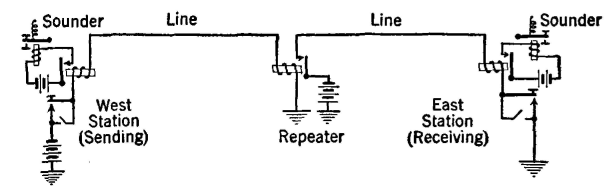
Neutral, or Single-Current, Telegraph Relays and RepeatersIn the circuit of Fig. 2, the received currents energize the sounders directly. In long lines, however, there is insufficient received energy to operate the sounders. In such instances the line is connected to a very sensitive relay (Fig. 5) instead of directly to the sounder. The operation of the relay by the incoming telegraph signals will control the battery in the sounder circuit, thus giving satisfactory sounder operation.
A telegraph repeater for telegraph transmission over very long distances is indicated in Fig. 5. The attenuated impulses coming in from the sending station are used to operate the relay which sends toward the receiving station an increased amount of power from the battery circuit. This simple arrangement is satisfactory for service in one direction only; that is, the receiving station cannot "break" the circuit and send to the other station. A repeater system which provided the breaking feature and permits transmission in both directions over one line wire was early developed.
|
|||
| Home Telegraph Systems Neutral, or Single-Current, Telegraph Relays and Repeaters |
|
||
Last Update: 2011-05-30