Iodine
 Like bromine, iodine is an element of the 7th main group and therefore has similar properties as well. Like bromine, iodine is an element of the 7th main group and therefore has similar properties as well.
It is an element we use in every day life without being aware of it. It is contained in almost every food (e.g. salt, carrots...).
Iodine is solid at room temperature and looks like small platelets of metal. If you put it into a glass tube and heat it, violet iodine vapours will escape, which gave iodine its name: Iodine means 'violet' in Greek.
 In the lab, we dissolved iodine platelets, once in alcohol and once in water. In alcohol (right) it dissolved much easier than in water (left). The iodine dissolved in water was light brown, the iodine in alcohol looked dark-brown. In the lab, we dissolved iodine platelets, once in alcohol and once in water. In alcohol (right) it dissolved much easier than in water (left). The iodine dissolved in water was light brown, the iodine in alcohol looked dark-brown.
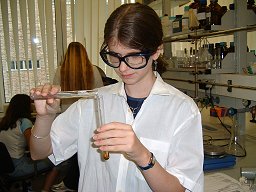 In the meantime, we had heated water, in which starch had been dispersed, above 90°C. We poured some of that water into a test tube and let it cool down. After a short period of time, we could pour the water with the dissolved starch into the water with the dissolved iodine. The solution turned violet. In the meantime, we had heated water, in which starch had been dispersed, above 90°C. We poured some of that water into a test tube and let it cool down. After a short period of time, we could pour the water with the dissolved starch into the water with the dissolved iodine. The solution turned violet.
The iodine dissolved in alcohol turned almost black after we added the water with the dissolved starch! The violet colour could only be suspected.
 If you want to try a similar experiment at home, this can be done easily: You need some iodine tincture and a potato. When you drop some of the tincture on the potato, the potato will turn blue to violet. If you want to try a similar experiment at home, this can be done easily: You need some iodine tincture and a potato. When you drop some of the tincture on the potato, the potato will turn blue to violet.
Applications of Iodine:
http://www.gesundheit.de/static/themen/erkrankungen/sonstige/schilddruese_iodversorgung.html
Iodine is contained in almost every food. Teenagers should take in approx. 200 micrograms per day. Sea fish contain the most iodine of all foods; fruits and vegetable contain only little.
In the case of radioactive contamination, potassium iodide tablets are provided: The harmless iodine is enriched in the thyroid gland, so the thyroid gland is no longer able to take up any contaminated iodine.
http://www.m-ww.de/gesund_leben/ernaehrung/mineral_spuren/jod.html
In the case of a lack of iodine, the following symptoms may occur:
- Tiredness
- Lack of motivation
- Disturbances of growth and development in children
- Increased need of sleep
- Difficulties concentrating
- Sensitiveness to cold
- Constipation
http://home.arcor.de/jodkrank/Ernahrung/Tabelle/tabelle.html
The iodine content of various foods in microgram per 100g:
|
|
Eel |
4,0 |
| |
|
Herring |
52,0 |
| |
|
Trout |
3,2 |
| |
|
Salmon |
34,0 |
| |
|
Peanut |
13,0 |
| |
|
Apple |
1,6 |
| |
|
Pear |
1,5 |
| |
|
Broccoli |
15,0 |
| |
|
Maize |
2,6 |
| |
|
Pumpkin |
1,4 |
| |
|
Asparagus |
7,0 |
| |
|
Tuna |
50,0 |
| |
|
Rice |
2,2 |
| |
|
Onion |
2.0 |
| |
|
Banana |
2,8 |
|
 Matter
