 Diet Carbohydrates The Structure of Carbohydrates

| You are viewing text created during the EU sponsored project "Kids & Science". More information on this project can be found on the project Web site: www.kidsandscience.org |
| Kids&Science Diet Carbohydrates The Structure of Carbohydrates |
|
| See also: About Caramels and Burning Sugar, Carbohydrates: They Give Us Energy | |
The Structure of CarbohydratesWhy the term 'carbohydrate' is actually wrong.All kinds of sugars, starch and cellulose belong to the nutrient group called carbohydrates. All of these components are made of the same kind of building blocks and contain the elements carbon, hydrogen and oxygen. Hydrogen and oxygen atoms occur at the ratio 2:1 in every molecule, exactly as in water H2O. Therefore it was initially believed that these were compounds of carbon with water, so hydrates of carbon. What Are the Building Blocks of the Carbohydrates?
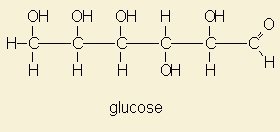
The smallest units are the so-called simple sugars or monosaccharides. These are molecules that consist of 3 to 7 carbon atoms, always carry a C=O group and many OH groups, which are responsible for the sweet taste and good solubility. The molecules are also able to form ring structures. An important monosaccharide is glucose (grape sugar) with the totals formula C6H12O6, which occurs in fruits and honey. Other representatives are fructose (fruit sugar), which occurs in fruits and honey and galactose. What Kinds of Carbohydrates Are There and Where Do They Occur?There are three groups of carbohydrates. Besides the already mentioned monosaccharides, which are the simplest type, there are bigger carbohydrate molecules that are composed of several monosaccharide building blocks.
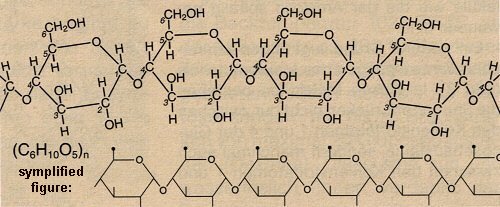
Starch is formed by plants as a carbohydrate storage form. It is contained in potatoes and cereals, for example. It can be used to thicken sauces or to starch laundry. Glycogen (animal starch) is the form our body uses to store carbohydrate reserves in the liver and the muscles. Cellulose (wood pulp) is a stable structural substance, which gives strength to plant cells. Cotton wool consists of pure cellulose. It is manufactured into textile fibres. Wood contains a large amount of cellulose, too. It is used to produce paper. In contrast to starch and glycogen, we are not able to digest cellulose. It represents a fibre. A surprising common element: All of the mentioned polysaccharides are made up of the same monosaccharides, namely glucose! The crucial difference causing their different properties is the way in which the building blocks are linked and the length and the branching of the chains. |
| Material courtesy of Kids&Science Foundation |
Web space and technical support provided by Epina GmbH |
Last Update: 2004-Feb-29 |
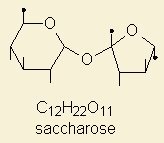
 Disaccharides are composed of two linked monosaccharides. They can be split by acids.
 Polysaccharides form the third group. They are giant molecules of up to a thousand linked monosaccharides. Because of their size, they differ from mono- and disaccharides: They do not taste sweet and they are no longer water-soluble for the most part. In order to be able to utilise them, polysaccharides have to be broken down into the initial individual building blocks by enzymes during digestion.