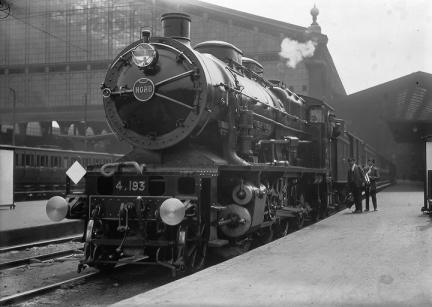
Transport On the Rails Steam Locomotive

| You are viewing text created during the EU sponsored project "Kids & Science". More information on this project can be found on the project Web site: www.kidsandscience.org |
| Kids&Science Transport On the Rails Steam Locomotive |
|
| See also: Steam Turbine - Water as Energy Carrier, Steam Distillation | |
Steam LocomotiveAfter the invention of the steam engine by James Watt in 1769, the invention of the steam locomotive was probably the next big step. Around 1800, 1804 to be exact, Richard Trevithick built the first model. However, the first steam locomotive that became established for a longer period of time was the model by Stevenson, who is wrongly believed by many people to be the inventor of the steam locomotive.
The early models only reached a speed of about 25 km/h. In those times, that was considerably fast. From Wood to MotionThe steam locomotive transforms the energy bound in the wood into kinetic energy. This is brought about by the incineration in the firing system. Coal and petroleum are used as 'fuel' as well. The thermal energy generated during the burning is transmitted to the water in the boiler. The water evaporates and is heated to approx. 350°C by overheating elements. This very hot steam has a lot of energy stored in the form of pressure and heat. It is channelled into an element called a piston steam engine, where the thermal energy is transformed into mechanical energy. You can imagine the piston steam engine like a car engine with cylinders and valves. It is just that the fuel isn’t petrol, but hot water vapour under pressure. Then, the mechanical energy is transmitted to the driving axles via a connecting rod, and thus transmitted to the rails. |
| Material courtesy of Kids&Science Foundation |
Web space and technical support provided by Epina GmbH |
Last Update: 2004-Feb-29 |