 Life Miscellaneous Ticks - a Danger for Humans

| You are viewing text created during the EU sponsored project "Kids & Science". More information on this project can be found on the project Web site: www.kidsandscience.org |
| Kids&Science Life Miscellaneous Ticks - a Danger for Humans |
|
|
Ticks - a Danger for Humans
In summer it may well happen that you return from a ramble in nature with an uninvited guest. The danger lurks in the grass: Small creatures climb on your body while you are playing in the lawn. They want your blood. With their saw-like mouthparts they make an opening in the topmost layer of the skin, anaesthetise the wound with poisonous saliva and completely sink their proboscis into it. It doesn’t take long until the female tick has gained up to 200 times its original weight. Approx. 850 species of these blood-sucking arachnids are known today. Most species only attack particular hosts, but the common castor-bean tick (Ixodes ricinus) is also inclined to attack humans from time to time. The Life of a Tick
The females suck blood once again for a last time to produce between 2000 and 3000 eggs. As soon as the eggs are spawned, the female ticks die. Males have an even shorter life. As soon as they are sexually mature, they let themselves drop onto a host, hoping to find a female there. After they have passed on their genes, they die instantly. It is not exactly known whether the males feast a third time or not. The entire life cycle of a tick takes about three years. Small, But Still Very Dangerous For HumansThe not only unpleasant, but also dangerous concomitants of a tick bite are illnesses, which are transmitted by bloodsuckers. The most common and most dangerous one is the tick borne encephalitis (TBE), a disease caused by viruses affecting the brain and the meninx.
|
| Material courtesy of Kids&Science Foundation |
Web space and technical support provided by Epina GmbH |
Last Update: 2004-Feb-29 |
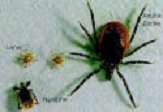 The tick gets by on three meals per life! The larva of the castor-bean tick, which is only half a millimetre big, attacks a small mammal at first. After this first refreshment, it sheds its skin and develops into a nymph (asexual). Afterwards, it fortifies itself again, this time with the blood of a bigger animal. Now it is able to grow up into a sexually mature animal at last.
 In addition, the ticks can carry vicious bacteria (e.g. Borreliae in the tick’s intestine), which might be transmitted to the host (human). One of the accompanying symptoms is the circular ring that develops around the bite. At an early stage, Lyme disease can be treated very well, but if the symptoms go undetected by the doctor, arthritis and other late sequela may occur after a while.