| Lectures on Physics has been derived from Benjamin Crowell's Light and Matter series of free introductory textbooks on physics. See the editorial for more information.... |
|

Home  Newtonian Physics Gravity Newton’s Law of Gravity Newtonian Physics Gravity Newton’s Law of Gravity |
|||||||||||||||||||||||||||||||||||||||||||


 Search the VIAS Library | Index Search the VIAS Library | Index
|
  |
||||||||||||||||||||||||||||||||||||||||||
|
Newton’s Law of Gravity
The sun's force on the planets obeys an inverse square law.Kepler's laws were a beautifully simple explanation of what the planets did, but they didn't address why they moved as they did. Did the sun exert a force that pulled a planet toward the center of its orbit, or, as suggested by Descartes, were the planets circulating in a whirlpool of some unknown liquid? Kepler, working in the Aristotelian tradition, hypothesized not just an inward force exerted by the sun on the planet, but also a second force in the direction of motion to keep the planet from slowing down. Some speculated that the sun attracted the planets magnetically. Once Newton had formulated his laws of motion and taught them to some of his friends, they began trying to connect them to Kepler's laws. It was clear now that an inward force would be needed to bend the planets' paths. This force was presumably an attraction between the sun and each planet. (Although the sun does accelerate in response to the attractions of the planets, its mass is so great that the effect had never been detected by the prenewtonian astronomers.) Since the outer planets were moving slowly along more gently curving paths than the inner planets, their accelerations were apparently less. This could be explained if the sun's force was determined by distance, becoming weaker for the farther planets. Physicists were also familiar with the noncontact forces of electricity and magnetism, and knew that they fell off rapidly with distance, so this made sense. In the approximation of a circular orbit, the magnitude of the sun's force on the planet would have to be [1] F = ma = mv2/r . Now although this equation has the magnitude, v, of the velocity vector in it, what Newton expected was that there would be a more fundamental underlying equation for the force of the sun on a planet, and that that equation would involve the distance, r, from the sun to the object, but not the object's speed, v - motion doesn't make objects lighter or heavier.
Equation [1] was thus a useful piece of information which could be related to the data on the planets simply because the planets happened to be going in nearly circular orbits, but Newton wanted to combine it with other equations and eliminate v algebraically in order to find a deeper truth. To eliminate v, Newton used the equation
Of course this equation would also only be valid for planets in nearly circular orbits. Plugging this into eq. [1] to eliminate v gives
This unfortunately has the side-effect of bringing in the period, T, which
we expect on similar physical grounds will not occur in the final answer.
That's where the circular-orbit case, T
F (Since Kepler's law of periods is only a proportionality, the final result is a proportionality rather than an equation, and there is this no point in hanging on to the factor of 4π2.) As an example, the "twin planets" Uranus and Neptune have nearly the same mass, but Neptune is about twice as far from the sun as Uranus, so the sun's gravitational force on Neptune is about four times smaller.
The forces between heavenly bodies are the same type of force as terrestrial gravity.OK, but what kind of force was it? It probably wasn't magnetic, since magnetic forces have nothing to do with mass. Then came Newton's great insight. Lying under an apple tree and looking up at the moon in the sky, he saw an apple fall. Might not the earth also attract the moon with the same kind of gravitational force? The moon orbits the earth in the same way that the planets orbit the sun, so maybe the earth's force on the falling apple, the earth's force on the moon, and the sun's force on a planet were all the same type of force.
There was an easy way to test this hypothesis numerically. If it was
true, then we would expect the gravitational forces exerted by the earth to
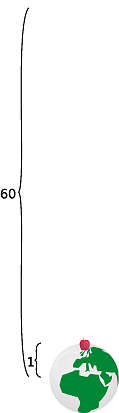
follow the same F Fearth on apple = k mapple/r2 earth Fearth on moon = k mmoon/d2 earth-moon . Newton's second law says a = F/m, so aapple = k / r2 earth amoon = k / d2 earth-moon . The Greek astronomer Hipparchus had already found 2000 years before that the distance from the earth to the moon was about 60 times the radius of the earth, so if Newton's hypothesis was right, the acceleration of the moon would have to be 602 = 3600 times less than the acceleration of the falling apple.
Applying a = v2/r to the acceleration of the moon yielded an acceleration that was indeed 3600 times smaller than 9.8 m/s2, and Newton was convinced he had unlocked the secret of the mysterious force that kept the moon and planets in their orbits.
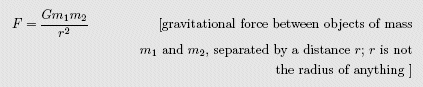
Newton's law of gravity
The proportionality F
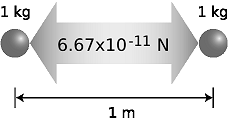
Newton conceived of gravity as an attraction between any two masses in the universe. The constant G tells us the how many newtons the attractive force is for two 1-kg masses separated by a distance of 1 m. The experimental determination of G in ordinary units (as opposed to the special, nonmetric, units used in astronomy) is described in section 10.5. This difficult measurement was not accomplished until long after Newton's death.
The proportionality to 1/r2 in Newton's law of gravity was not entirely unexpected. Proportionalities to 1/r2 are found in many other phenomena in which some effect spreads out from a point. For instance, the intensity of the light from a candle is proportional to 1/r2, because at a distance r from the candle, the light has to be spread out over the surface of an imaginary sphere of area 4πr2. The same is true for the intensity of sound from a firecracker, or the intensity of gamma radiation emitted by the Chernobyl reactor. It's important, however, to realize that this is only an analogy. Force does not travel through space as sound or light does, and force is not a substance that can be spread thicker or thinner like butter on toast.
Although several of Newton's contemporaries had speculated that the force of gravity might be proportional to 1/r2, none of them, even the ones who had learned Newton's laws of motion, had had any luck proving that the resulting orbits would be ellipses, as Kepler had found empirically. Newton did succeed in proving that elliptical orbits would result from a 1/r2 force, but we postpone the proof until the end of the next volume of the textbook because it can be accomplished much more easily using the concepts of energy and angular momentum.
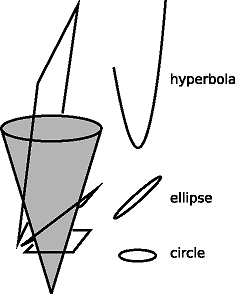
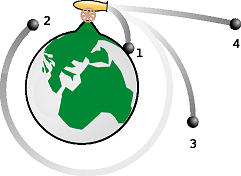
Newton also predicted that orbits in the shape of hyperbolas should be possible, and he was right. Some comets, for instance, orbit the sun in very elongated ellipses, but others pass through the solar system on hyperbolic paths, never to return. Just as the trajectory of a faster baseball pitch is flatter than that of a more slowly thrown ball, so the curvature of a planet's orbit depends on its speed. A spacecraft can be launched at relatively low speed, resulting in a circular orbit about the earth, or it can be launched at a higher speed, giving a more gently curved ellipse that reaches farther from the earth, or it can be launched at a very high speed which puts it in an even less curved hyperbolic orbit. As you go very far out on a hyperbola, it approaches a straight line, i.e., its curvature eventually becomes nearly zero. Newton also was able to prove that Kepler's second law (sweeping out equal areas in equal time intervals) was a logical consequence of his law of gravity. Newton's version of the proof is moderately complicated, but the proof becomes trivial once you understand the concept of angular momentum, which will be covered later in the course. The proof will therefore be deferred until section 5.7 of book 2.
→ Solved problem: Visiting Ceres page 255, problem 10 → Solved problem: Geosynchronous orbit page 257, problem 16 → Solved problem: Why a equals g page 255, problem 11 → Solved problem: Ida and Dactyl page 255, problem 12 → Solved problem: Another solar system page 256, problem 15 → Solved problem: Weight loss page 257, problem 19 → Solved problem: The receding moon page 257, problem 17
Discussion Questions
|
|||||||||||||||||||||||||||||||||||||||||||
| Home Newtonian Physics Gravity Newton’s Law of Gravity |
|
||||||||||||||||||||||||||||||||||||||||||


 r3/2, of Kepler's law of periods
comes in. Using it to eliminate T gives a result that depends only on the
mass of the planet and its distance from the sun:
r3/2, of Kepler's law of periods
comes in. Using it to eliminate T gives a result that depends only on the
mass of the planet and its distance from the sun: