| Transistor Basics is a free introductory textbook on transistors and their basic applications. See the editorial for more information.... |

|

Home  The Grounded Base Transistor General Four-Terminal Network Analysis The Grounded Base Transistor General Four-Terminal Network Analysis |
||


 Search the VIAS Library | Index Search the VIAS Library | Index
|
  |
|
|
General Four-Terminal Network AnalysisAuthor: Leonard Krugman
E1 = Z11I1 + Z12I2 and E2 = Z21I1 + Z22I2 where Z11 is the input impedance with the output open. The equivalent current (nodal) equations are I1 = Y11E1 + Y12E2 and I2 = Y21E1 + Y22E2 where Y11 is the input admittance with the output shorted. Amplification factors are the best general index of an active network. Since the general case may have amplification in both directions, definitions are included for forward and reverse directions. The forward current amplification factor, α21, is equal to the negative ratio of the current at the shorted output terminals to the current at the input terminals. a21 = -I2/I1 when E2 = 0 Then 0 = E2 = Z21I1 + Z22I2. Solving these equations a21 = -I2/I1 = Z21/Z22 and in terms of admittance a21 = -Y21/Y11 The reverse current amplification factor, α12, is equal to the negative ratio of the current at the shorted input terminals to the current at the output terrminals: a12 = -I1/I2 when E1 = 0 Then 0 = E1 = Z11I1 + Z12I2. Solving as before, a12 = -I1/I2 = Z12/Z11, and in terms of admittances a12 = -Y12/Y22 The forward voltage amplification factory, μ21, is equal to the ratio of the open circuit output voltage to the input voltage. Thus The reverse voltage amplification factor μ12 is equal to the ratio of the open circuit input voltage to the output voltage.
|
||
| Home The Grounded Base Transistor General Four-Terminal Network Analysis |
|
|
 , when I2 = 0. On this basis, E1 = Z11I1 and E2 = Z21I1.
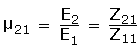 and on an admittance basis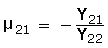
 when I1 = 0. Then E1 = Z12I2 and E2 = Z22I2. Thus
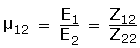 In terms of admittance
 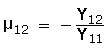 .
.
Last Update: 2010-11-17