 Matter Plastics Household Plastics

| You are viewing text created during the EU sponsored project "Kids & Science". More information on this project can be found on the project Web site: www.kidsandscience.org |
| Kids&Science Matter Plastics Household Plastics |
|
| See also: Plastics- What? Where? When?, Synthetics - an Attractive Thing | |
Household PlasticsWithin the last 60 years, plastics have set out on a victorious advance through all fields of daily life! Traditional materials like wool, paper, glass, ceramic, cotton and metal have been totally or partially replaced by polystyrene, polyvinyl chloride, polyethylene, polypropene and co. How Do You Recognise Products Made of Plastic?Most objects made of plastic carry a label. Thanks to a letter code it is easy to find out what you are dealing with:
Besides the letter code, plastics are also often labelled with a number in the symbol. If there is no labelling, the following test can help: Put a piece of plastic into a glass of water. PE and PP float on the surface (they are lighter than water), PS and PET sink. Plastics In the Kitchen
|
| Material courtesy of Kids&Science Foundation |
Web space and technical support provided by Epina GmbH |
Last Update: 2004-Feb-29 |

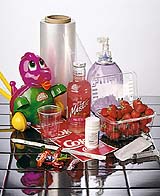 When you look around in the kitchen and the fridge, you will find numerous types of plastics. Today’s 'supermarket society' with all its packaging would not be possible without the help of plastics. We drink from PET bottles, eat yoghurt out of PS cups, most wrappings are made of PE and meat comes in Styrofoam trays. In most kitchens there is usually a garbage bin made of plastic and the salad bowl often consists of PET. In modern kitchens, the floor is either tiled or laid with PVC. The boards of built-in kitchens are made of chipboards, in which the compressed wood chips are held together by a polymer (often formaldehyde resin). The decorative surface consists of printed paper that is firmly attached to the chipboard by a melamine resin. In addition, the resin renders the board resistant to heat and mechanical wear and tear.
 By the way, the frying pan is coated with Teflon so that nothing burns!