Synthetics - an Attractive Thing
 When Wallace H. Carothers discovered nylon (polyamid), rather accidentally, in 1938, synthetics started to leave silk, cotton and Co. far behind. The women were after the new product in droves, and when production of tights was stopped during the Second World War, since nylon was only allowed to be used for the manufacturing of parachutes, a brisk trade with the much sought-after 'nylons' sprang up on the black market. When Wallace H. Carothers discovered nylon (polyamid), rather accidentally, in 1938, synthetics started to leave silk, cotton and Co. far behind. The women were after the new product in droves, and when production of tights was stopped during the Second World War, since nylon was only allowed to be used for the manufacturing of parachutes, a brisk trade with the much sought-after 'nylons' sprang up on the black market.
But synthetics do not only clothe the legs, and there are several good reasons for that. Synthetics (that’s what fabrics that are entirely or partially produced using synthetic material are called) are cheaper in the production, easier to care for and give a good fit. They enable the manufactures to provide their products with several especially practical properties: high elasticity, rapid drying, acceptance of multiple dyes, colour-fastness, breaking strength, shining or shimmering surfaces, water-repellent surfaces, lightness and many more.
Pullover, Dress and Jacket
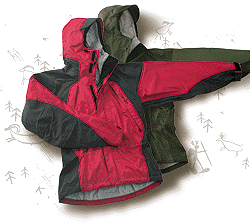 Pullovers usually still consist partly of wool, which is mixed with polyacrylonitrile, polyamide or polyester. Pullovers can also be made entirely of synthetic fibres. For example, some knitwear is completely made of viscose. Viscose - artificial silk - is also the fabric many summer dresses are made of. The reason is that this material falls softly and flowingly and is agreeable to wear. Pullovers usually still consist partly of wool, which is mixed with polyacrylonitrile, polyamide or polyester. Pullovers can also be made entirely of synthetic fibres. For example, some knitwear is completely made of viscose. Viscose - artificial silk - is also the fabric many summer dresses are made of. The reason is that this material falls softly and flowingly and is agreeable to wear.
In order to make jackets waterproof, they are coated with acrylic. If they have to be breathable at the same time, microporous membranes made of polyurethanes are applied to a supporting fabric as foils. Fabrics for jackets are made of microfibres that are fibres, which have a thickness of only one tenth of a human hair, and consist of polyamide, polyester or acrylic. In the end, the jackets are lined with viscose, cellulose acetate, polyester or nylon.
Good Old Jeans
 Today, jeans are made of cotton like in the times of their inventor. So what do they have to do with synthetics? Well, without synthetics, the jeans would not hold together - the thread, which gives them shape, is made of polyester, a synthetic fibre! If you wear stretch jeans, this means the cotton was mixed with elastane - an elastomer based on polyurethane, which can be stretched by 500-700% and afterwards return to its original shape. Today, jeans are made of cotton like in the times of their inventor. So what do they have to do with synthetics? Well, without synthetics, the jeans would not hold together - the thread, which gives them shape, is made of polyester, a synthetic fibre! If you wear stretch jeans, this means the cotton was mixed with elastane - an elastomer based on polyurethane, which can be stretched by 500-700% and afterwards return to its original shape.
Elastane is not only used for stretch jeans, but also for almost all other elastic clothes due to its high elasticity and form stability: bands, socks, woollen tights, cycle shorts, bathing suits and sport shirts. On the label you will not only find elastane, but also the important brand names Lycra® and Dorlastan®.
|
 Matter
