Diet Fats and Oils The Structure of Fats Fatty Acids

| You are viewing text created during the EU sponsored project "Kids & Science". More information on this project can be found on the project Web site: www.kidsandscience.org |
Fatty AcidsFatty acids can be demonstrated with a simple experiment:
A mixture of ethanol and lard is carefully heated. Afterwards, a moist strip of litmus paper is placed in the rising vapours. In this experiment, a red hue indicates an acid. At the formation of fat (glycerine reacts with 3 fatty acids) 3 molecules of water (glycerine > OH-group; oleic acid > H-atom) are split off. Fatty acids can be classified as:
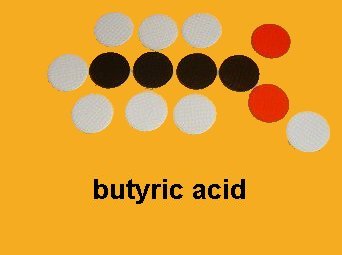
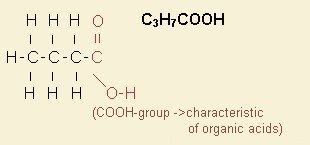
Example of a saturated fatty acid:Butyric acid:
Enough hydrogen atoms are present, so that no double bond is formed in the carbon-hydrogen chain. Example of an unsaturated fatty acid:Oleic acid C17H33COOH:
Hydrogen atoms are missing, therefore double or triple bonds are formed in the carbon-hydrogen chain. The quality of edible fats is determined by their chemical structure. Besides the number of C=C double bonds , the chain length of the fatty acids is important.There are short, medium and long-chained fatty acids. The body can produce saturated fatty acids on its own. Multiple unsaturated fatty acids like linoleic acid, however, have to be taken along with the food. These fatty acids are called essential. Short-chained fatty acids possess 4-6 carbon atoms, e.g. butyric acid. Long-chained fatty acids possess 14-20 carbon atoms, e.g. stearic acid. Liquid fats (oils) always contain unsaturated fatty acids. They are healthier and prevent heart disease. |
| Material courtesy of Kids&Science Foundation |
Web space and technical support provided by Epina GmbH |
Last Update: 2004-Feb-29 |